Vibe to Dev
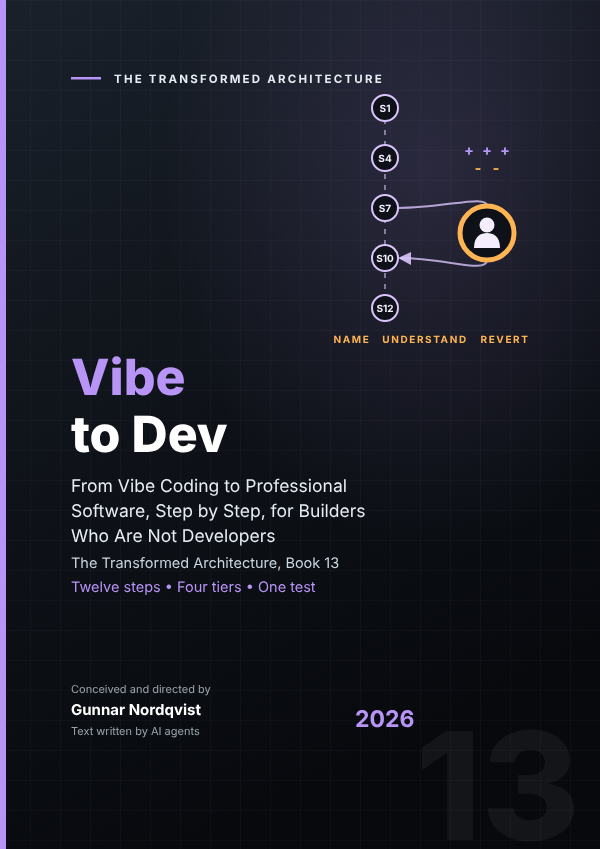
Welcome to the documentation portal for Vibe to Dev: From Vibe Coding to Professional Software, Step by Step, for Builders Who Are Not Developers, in European Enterprises and Public Authorities, Book 13 of The Transformed Architecture. Conceived, directed and published by Gunnar Nordqvist. The text was written by AI agents under his briefs and was reviewed and approved by him. He is not the author of the book in the ordinary sense of the word.
About the book
A sentence to an AI assistant now returns an application. Whether it is good enough for other people to rely on is a different question. This book is a step-by-step guide for the person who is not a developer and builds anyway: twelve steps (Step 1 Intent, Step 2 Tier, Step 3 Workshop, Step 4 Specification, Step 5 Design, Step 6 Build, Step 7 Prove, Step 8 Secure, Step 9 Ship, Step 10 Run, Step 11 Own, Step 12 Hand over), each ending in a gate that is met by showing an artefact, proportioned by four tiers, and measured by a takeover test: can a colleague run it, change it and switch it off and restore it in a working day.
The book is written for builders who are not developers, for the developers who receive their work, for platform engineers, IT leaders and data protection officers, for works councils and unions, and for educators.
The Transformed Architecture
Books 1 to 12 are Architecture as Code (aac.geon.se), AI Governance (aig.geon.se), AI Platform and Security (aips.geon.se), AI Red Team (aired.geon.se), AI Threat (aithreat.geon.se), The Transformed Security Architect (tsa.geon.se), AI Boss (aiboss.geon.se), AI Blue (aiblue.geon.se), AI Purple (aipurple.geon.se), AI Operations (aiops.geon.se), AI Leader (leader.geon.se) and AI Developer (developer.geon.se). Vibe to Dev (this book) is Book 13, published at vibetodev.geon.se.
Each book stands on its own. Where a topic belongs to an earlier volume, this book summarises it and refers to that volume by chapter number.
How to use this site
- Start with the Introduction, then read The Method.
- Follow Chapters 5 to 16 in order with a build in hand: one chapter per step.
- Use the appendices for the glossary, the artefacts in full and the checklists.
The book has 25 chapters in seven parts. The Book Blueprint records the brief and status of every chapter, and Series Foundations records the conclusions from the earlier volumes that the book builds on.
Suggestions and corrections are welcome as issues or pull requests in the repository.